
Agronomy Research Section
Since 1901, when the Department of Agriculture was established, research on crop systems has begun. In 1954, the Agricultural Research Institute was established in Insein Gyogone with five departments, including the Department of Agriculture, which has been conducting research on paddy cultivation methods since 1964. In 1971, it was relocated from Gyogone to Yezin. In 1978, according to the constitution, there were seven crop departments and five support units. Since 1979, we have been cooperating with the International Rice Research Institute in the Philippines on crop design research. Research on paddy cultivation methods began in 1981-82. Since the establishment of the Department of Agricultural Research in 2004, it has been operating as a Crop System Division of the Crop System and Agricultural Economics Research Division out of seven divisions, conducting research on crop production methods.

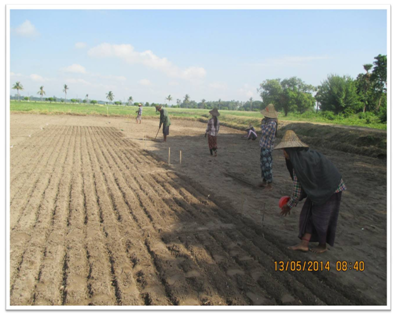

Ongoing Research
The Crop System Division is conducting research for the following purposes:
(1) Find the most profitable and suitable crop models for soil conservation
(2) To develop planting methods for published and published paddy varieties
(3) To study weed control methods for paddy crop
(4) Foundation Seed requested by the Department of Agriculture for Seed Flow and for the continuous production of pure seeds for farmers.
(1) Research on crop rotation
Research on crop yields is being carried out on the most profitable and fertile soil-based crop model research and the field crop-based crop design research. Leway According to the results of research conducted by the Department of Crop Systems and farmers in the Yezin area, the following economically viable crop yields and sustainable crop yields were identified as follows:
(B) Research on paddy cultivation with a cultivator
The use of machines to play a key role in the transition to modern agriculture. At present, it is used for planting paddy. We are facing labor shortage at harvest time. At the same time, to be able to use agricultural machinery skillfully for the transition to mechanized farming system. Finding the right farming methods for the type of machine you are going to grow and the type of machine you are going to use is one that needs to be done.
Paddy farmers are suffering from the shortage of manpower, which can result in the inability of seedlings to grow on time and the loss of seedlings and air loss. To solve this problem, the threshing machine must be installed correctly. You need to be able to use it skillfully. Harvesting machines were invented by Kubota corp in Japan in the 1960s and were used in East and South Asia in the 1970s and 1980s (wikipedia). Harvesters are now available locally at a price of 150,000 Lakhs. 245 lakhs for 8th grade Kubota; 152 lakhs for 6th grade Kubota; And There are two types of cultivators: riding type and driver type.
.
Advantages of using a cultivator
- Solve labor shortages in the field due to low labor costs. Planting distance evenly and full number of plants.
- uniform depth of seedlings.
- Fast tillage and vigor.
- Small area required for cultivation.
- Save time.
- Reduce seed rate.
Requirements for using a cultivator
- Need for skilled drivers.
- Not suitable for cultivation in areas with difficult access.
- The need for systematic cultivation and nursery.
- The field needs to be easily drained before planting.

The transition to mechanized farming in the paddy production system will lead to greater activity. Due to weather constraints, harvesting can be completed on time. Reducing wastage can increase yields per acre and increase per capita income. This will not only ensure the state’s food security, but also increase the country’s revenue by exporting it abroad, which will have the benefit of boosting the country’s economy.
Starting from 2015, the Department of Crop Systems will use a cultivator to select paddy fields suitable for planting. ၊ Type of nursery land; Research activities such as soil ratio were carried out.
According to the 2015 rainy season test results, at 18 days of age, the soil is fertile. A mixture of blue and green straw with a ratio of 3: 2: 1 and planting at a distance of 12 x 4 inches between rows was found to provide the best yields.
(၂) စပါးစိုက်နည်းစနစ်သုတေသန

(c) Seedling Cultivation Research (SRI)
Transplanted Rice (TPR) in Myanmar; Wet Seeded Rice (WSR); Direct Seeded Rice (DSR) In the cropping system, planting in rows; And random planting. It can be sown in direct wet field and in dry seed plowing system. It is usually planted by sowing seeds in rows.
System of Rice Intensification – SRI was introduced in Myanmar in 2000. Therefore, in the 2014-2015 rainy season, the SRI system was compared with the conventional farming system using the Sinthukha paddy variety.
In the SRI system, 12 seedlings per acre were planted in a nursery system. At 8 days of age, the seedlings were transplanted to a planting hole spaced 10 “x 10” between rows. In the conventional farming system, the seed rate was 1.5 baskets per acre. At 20 days of age, seedlings were transplanted to a planting hole spaced 8 “x 6” between rows.
According to the findings, the SRI system yielded 105.83 baskets per acre and the conventional system yielded 81.88 baskets. In SRI system, good yields are obtained by increasing the number of seeds per acre; This is due to higher yields and higher success rates. In addition, SRI cultivation was 22.5 times cheaper per acre than conventional cultivation.
(D) Research on paddy cultivation methods
In addition to cultivating paddy, direct seeding in wet areas; Direct irrigation methods can be used in wet areas. Technical experiments for paddy cultivation and direct seeding have been carried out at field research institutes, including Yezin.
In paddy cultivation, the seeds can be planted directly without sowing. Direct sowing can be done by dry plowing or cultivating. It can be grown on wet soil or sown. With your hands outstretched; This can be done using a seeder.
Reduced planting costs by direct sowing; Addressing labor shortages; By planting early, the second crop can be planted on time. You can get benefits such as more efficient use of water.


These techniques have been successfully tested in several regional crop design research institutes, including Yezin (Department of Crop Systems) since 1979-80, and the direct seeding system in wetlands has been widely used in various summer paddy townships since 1992-93. In dry plowing, sowing system is used in deep-sea areas; It is successfully cultivated in Pindaya Township and Kalaw Township, Shan State, in areas with uncertain rainfall in upper Myanmar.
Now, as the climate changes, so does the pattern of rainfall. Incorrect monsoon season; Water scarcity; Lack of timely irrigation water for paddy cultivation; Factories such as labor shortages are forcing direct seeding of paddy not only in summer but also in the rainy season. Therefore, there is a need to further research and develop paddy cultivation methods that are adapted to the changing climate. Wet Seeded Broadcast (WSB); Handicraft cultivation; Cultivation methods are being tested called WSR.


(3) Weed Research
Up to 30% of paddy loss due to weed problems. Therefore, weed research is being carried out at the Crop System Division. The weed research carried out included weeding tests according to the age of the paddy; Finding a time for weeding in paddy; Competitiveness with rice varieties; Weed control methods; How to use herbicides Competitiveness with nitrogen in paddy fields.
In addition, climate change has led to a shortage of irrigation water; Weed problems are becoming more and more important as direct seeding methods are increasingly used due to the lack of irrigation water at the time of planting. The main problem with direct seed paddy cultivation is the high weed germination. Joining hands to control weeds; It is more effective not only with the use of cultural control methods, such as the use of weeders, but also in combination with the use of chemical control. Therefore, to know the appropriate herbicides and methods for use in paddy fields, there are ready-made herbicides on the market. Research on new herbicides is also underway.
Today, labor shortages, Reduced rainfall; Irregular rainfall patterns; Due to the lack of irrigation water, the cultivation of paddy seeds has become more important in the dry season than in the cultivation system. Weed problems are a more important challenge than in dry farming systems. During the rainy season from 2012 to 2014, the Department of Crop Systems of the Yezin Agricultural Research Department used dry paddy to dry the land. The research was conducted for 3 seasons to study the appropriate weed control method in dry seed paddy system.
According to the findings, post-emergence weed spraying + weeding at 45 days was the best yield (57.5 baskets / acre). Found The test showed that the average weed control efficiency was 60.44% and the average dry weight was the lowest, so the yield per acre was good.


(4) Cultivation of pure paddy seeds
To classify rice varieties according to the purity level:
- Breeder Seed (BS)
- Foundation Seed (FS)
- Registered Seed (RS)
- There are four levels of Certified Seed (CS):
Department of Rice’s Department of Agricultural Research propagates the parent seed (BS) and uses the (BS) seed to produce hybrid seed (FS) for crop production. Derived from (FS) seeds (RS); In addition, RS (CS) seeds are continuously cultivated.
Seed sorting needs to be done by skilled workers in the field of pure seed production. It is generally necessary to separate three times per crop per season. The time of the planting of the wheat; The flowering period and the ripening period. In addition to the use of skilled manipulation, the following four processes are performed to produce pure seed.
Today, labor shortages, Reduced rainfall; Irregular rainfall patterns; Due to the lack of irrigation water, the cultivation of paddy seeds has become more important in the dry season than in the cultivation system. Weed problems are a more important challenge than in dry farming systems. During the rainy season from 2012 to 2014, the Department of Crop Systems of the Yezin Agricultural Research Department used dry paddy to dry the land. The research was conducted for 3 seasons to study the appropriate weed control method in dry seed paddy system.
- Field inspection
- Seed Sampling
- Seed Testing
- Seed Certification
Paddy breeding is more common during the rainy season every year. In such a multiplication, if there is gold,Hmawbi-2, If the fruit is repeated, Yadanar Toe Seedlings are grown and cultivated according to the needs of the seed farms. Distribute Seed farms register one year in advance for the required variety of paddy. Based on these seed requests, the crop variety and acreage to be cultivated are determined.